

Blog Posts
Research Exchange to Swinburne University of Technology, Melbourne
by Soyun Jang
In November 2025, I visited the Centre for Transformative Media Technology at Swinburne University of Technology in Melbourne, Australia, for a 15-day research exchange. Recently having moved to a new location, the centre had acquired a large studio space for a motion capture system, social robotics, and a volumetric capture system. While a part of their research is geared towards creative applications of technology, the other part focuses on what they can learn from this creativity that is useful for those technologies. This latter research interest overlaps with my PhD project in performing arts and robotics, as well as the larger objective of the research consortium Dramaturgy for Devices.
During the exchange, I made great connections with the centre’s researchers, where we had in-depth conversations about our research interests. We talked about potential collaborations and sharing outputs where we can. Through their network, I was able to connect with some researchers at the University of Melbourne who share similar interests in robotics and artistic approaches. I participated in various research activities, including a presentation at a symposium about creative technologies, robot movement investigation, two short interviews, and providing dance data for the centre’s motion capture system, which will later be mapped onto a humanoid robot. While I cannot provide all of these valuable experiences in detail, I present below two activities that were especially memorable.
Presenting Attunement in HRI: Creative Technology and Transformative Storytelling Symposium (13-17 November 2025, Melbourne & Auckland).[i]
At this symposium, I presented my latest research[ii] on attunement in human-robot interaction (HRI). As part of the roundtable session, I discussed how attunement is a relevant concept for HRI design that foregrounds the adaptability and flexibility in how we humans can relate to more-than-human beings. This suggests that we can find creative ways to relate to radically different morphologies, and invite researchers to step away from relying on sameness (i.e., humanlikeness) in robot morphology and human-robot interaction. Furthermore, I presented case studies grounded in the performing arts that find creative ways of attuning to robots, demonstrating how the artistic field can inspire a reimagining of how we relate to robots.
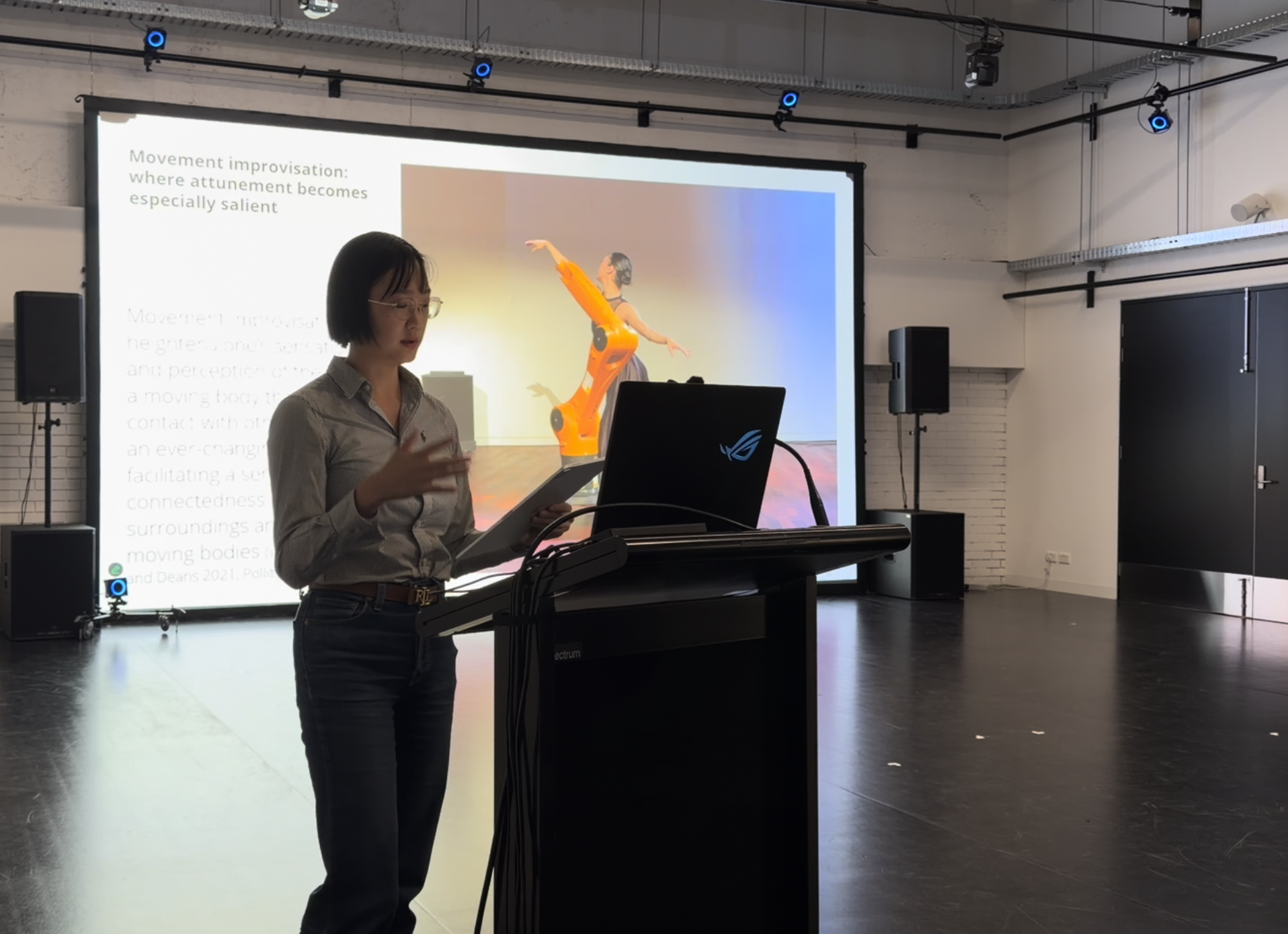
The symposium was mainly focused on creative works and processes that use the latest technologies, namely virtual reality and artificial intelligence, leaving little space for discussions about robotics. However, there were many projects in which the creative forces within the Swinburne University of Technology – and the support thereof – were inspiring and sharing knowledge with the more technical domains of research at the university. For instance, researchers in the media department were collaborating with those from the astrophysics department to create an AI-generated galaxy projection on a large-scale screen. In turn, the physics department would be using this system for education. While the content of this symposium did not directly inform my research interest in social robots and HRI, it was an opportunity to broaden my scope of how creative use of technology can yield useful knowledge beyond its own creative context.
Teaching G1 Unitree to Dance
The Centre for Transformative Media Technology has a newly acquired robot, the G1 Unitree. This bipedal, humanoid robot has limited upper body movement and legs that are programmed to balance itself against outside force and uneven terrains, as well as its own weight shift. I explored the movement of this robot by creating a short choreography in its “demo mode”. This mode allows for a manual manipulation of the robot for up to three minutes at a time, limited to its upper body. The movement generated through the manipulation is recorded on the robot and can be played back.
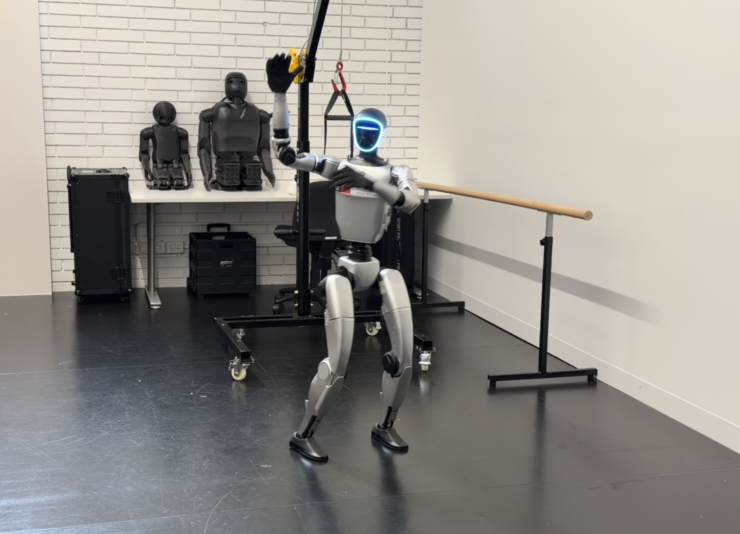
While the robot’s general morphology is humanoid, its joints are designed differently from ours. The shoulders are a combination of two axes that rotate in different directions, and the elbows bend and stretch a bit more than the average human. The robot has no wrist joints, but a rotating joint between the shoulder and the elbow, and another one between the elbow and where one would expect the wrist to be. The waist consisted of one large joint (rather than a spine that is a series of small joints) that twists from side to side – perhaps a little too far. The head movement was very limited, at least in this demo mode.
In exploring its movement, I quickly noticed that I cannot manipulate the robot’s arms the way I would another dancer’s. Because of the unique way in which the robot’s joints are designed, they often got twisted in directions I had not intended and became stuck, unable to perform another movement without first untangling their joints. Furthermore, due to the robot’s lack of head and leg movements, the robot would barely seem to ‘dance’ beyond moving its arms around in uncanny ways. Its arm joints were uncomfortably flexible, while the quality of its movement would be overly rigid. This was due to the lack of a spine, which, for humans, allows for a fluid twisting of the torso and head following the arm movement.
The most interesting movement qualities came about when the robot’s legs were moving. While the demo mode did not allow for a recording of the leg movement, I found that if large, fast arm and torso movements toppled the robot off-balance, it would automatically move its legs to keep itself standing. Taking advantage of this, the robot could be made to perform a grotesque kind of ‘slapstick’, where it would be waving its arms around and twisting its torso in extreme manners while trying to balance itself. Another interesting choreo was ‘the cha cha’, which consisted of concise arm movements close to its torso. Then, while the robot was playing back the recorded movement, I would manually manipulate the legs to walk a couple of steps back and forth and to the sides. While the robot cannot perform the fluid hip movements of a seasoned, human cha cha dancer, the way it catches its weight between the leg movements gave a unique quality to the robot’s performance.
______
This exchange has been fruitful not only in terms of making connections with colleagues across the globe, but has also given me inspiration going forward. Questions of materiality and movement continue to be recurring topics in HRI design. For instance, the experience of choreographing the humanoid robot, in addition to being asked to dance for collecting motion capture data, has made me rethink the ways in which we involve artists in various stages of HRI development. How do we ask them to engage with technology in ways that break out of their comfort zones? And how do we deal with the materiality that always fights back? While these are questions that I have already had for some time now, this exchange has made them spark differently in my brain, perhaps igniting ideas as to how they might be answered.
[i] This symposium was a hybrid research event co-hosted by the Centre for Transformative Media Technologies, Swinburne University of Technology (Melbourne, Australia) and the Virtual Creative Design Research Center, AUT University (Aukland, New Zealand).
[ii] This research was conducted in collaboration with Irene Alcubilla Troughton.